

Backgammon - Istanbul
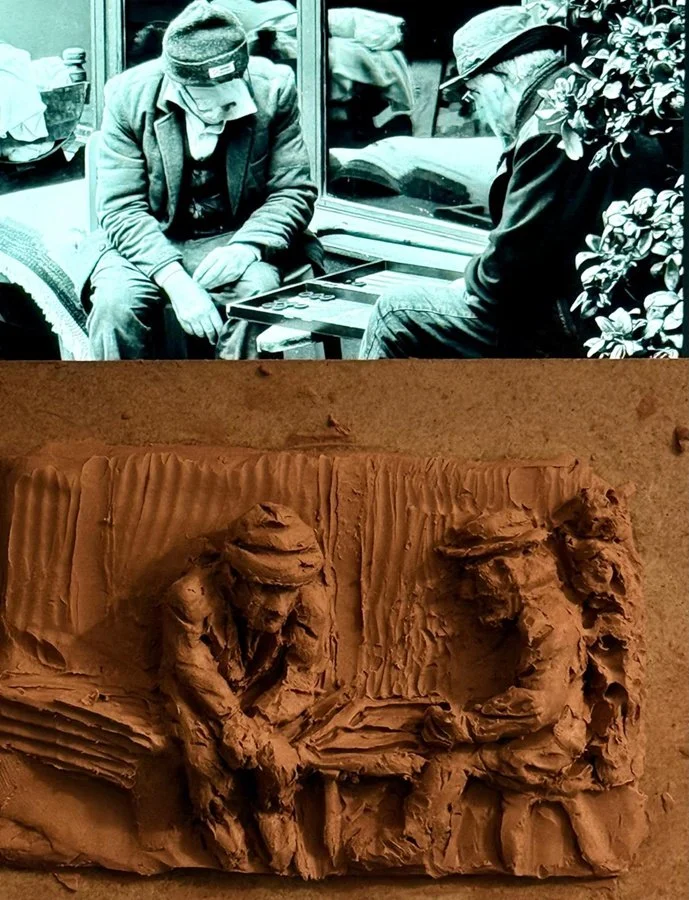
These gentlemen took a break from selling their antiques on a blustery afternoon for a few games of the preferred board-game in Istanbul - Backgammon.
I laid out this quick-sculpt in the neighborhood and put another hour into it at the apartment. Cold day!
History
In Istanbul, backgammon (known locally as Tavla) is more than just a game; it is a fundamental pillar of social life and a living connection to the city's Byzantine and Ottoman past.
Before it was the Turkish tavla, the game existed in Constantinople as Tabula. This Roman/Byzantine ancestor was played by emperors like Zeno (r. 474–491 AD), whose games were famously recorded in epigrams.
Archaeological finds in sites like Ephesus show that "tables" games were already ingrained in the culture of Anatolia long before the arrival of the Ottomans. When the Turks captured Istanbul in 1453, they didn't just inherit a city; they inherited a deeply rooted gaming culture that blended with Persian traditions of Nard.
Culture
The "golden age" of backgammon in Istanbul began in the 1550s with the opening of the first coffeehouses in the district of Tahtakale.
A Public Living Room: Coffeehouses (kahvehane) quickly became the heart of Istanbul's social life. While men gathered to drink coffee and discuss politics, the rhythmic clacking of dice on wooden boards became the city's background noise.
Symbolism: In Ottoman culture, the board was often seen as a microcosm of life:
24 points represent the hours of the day.
30 checkers represent the days of the month.
The dice represent the element of fate (Kismet).
Craftsmanship: Istanbul became a hub for master woodworkers who created exquisite boards using walnut, rosewood, and mother-of-pearl (sedef) inlays—a tradition that still thrives in the Grand Bazaar today.
Modern Culture: "Tavla" vs. Western Backgammon
Today, the game is ubiquitous in Istanbul, from the posh cafes of Nişantaşı to the gritty tea houses of Fatih or street games sculpted here. However, "Turkish Tavla" differs slightly from the international version:
Speed and Sound: Players in Istanbul play at a blistering pace, often rolling and moving with one hand while holding a glass of tea (ince belli) in the other.
The Doubling Cube: You will rarely see the doubling cube (used in Western competitive play) in a traditional Istanbul cafe; the Turkish game relies on a series of matches where the loser traditionally pays for the tea.
Dice Etiquette: It is common for players to "speak" to the dice or call out the numbers in a mix of Persian and Turkish (e.g., Dü-Şeş for 6-2 or Hep-Yek for 1-1).